It's Developmental Disabilities Awareness Month. Here's What That Means for IEP Families.
Mar 1, 2026
Expert IEP Care Team
Every March, we recognize Developmental Disabilities Awareness Month, a time dedicated to increasing understanding, promoting inclusion, and affirming the rights of people living with developmental disabilities. And while awareness campaigns are important, for the families we work with, awareness alone has never been enough.
If your child has a developmental disability and receives special education services, you already know that awareness doesn't write an IEP. Awareness doesn't show up to the meeting. Awareness doesn't make sure your child's goals are ambitious, their services are adequate, or their placement is appropriate.
Advocacy does that. And that starts with understanding your rights.
What Counts as a Developmental Disability?
Developmental disabilities are a group of conditions that begin during the developmental period, typically before age 22, and affect physical, cognitive, language, or behavioral development. These include autism spectrum disorder, intellectual disabilities, cerebral palsy, Down syndrome, ADHD, and many others.
Under the Individuals with Disabilities Education Act (IDEA), children with qualifying disabilities are entitled to a Free Appropriate Public Education (FAPE) through an Individualized Education Program. That word "appropriate" is doing a lot of heavy lifting, and it's where most of the advocacy happens.
Awareness vs. Action
Awareness month is a good time to educate communities, share resources, and celebrate the lives of people with disabilities. But for IEP families, we want to push the conversation further.
Awareness says "include children with disabilities." Action says "here's how we make sure the IEP actually reflects what inclusion looks like for my child."
Awareness says "every child deserves support." Action says "show me the data that supports reducing my child's speech therapy from three times a week to once."
Awareness says "these children have potential." Action says "then write IEP goals that reflect that potential, not goals designed to be easy to meet."
We've worked with over 4,200 families, and the pattern we see again and again is that the system acknowledges disabilities but doesn't always respond to them with the urgency and specificity that families deserve.
What You Can Do This Month
If your child has a developmental disability and an IEP, use this month as a checkpoint.
Pull out your child's current IEP and read it with fresh eyes. Are the goals still relevant? Are services being delivered as written? Has anything changed in your child's needs that the IEP doesn't reflect? Not sure what you're looking at? Start with our breakdown of every section of the IEP and what to look for.
Talk to your child's teachers. Ask how things are going, not just academically but socially, behaviorally, and functionally. Get specifics, not generalities.
Connect with other families. One of the most powerful things you can do is find a community of parents who understand what you're going through. You learn faster, you feel less alone, and you get better at advocating when you're not doing it in isolation.
Know your rights. If you haven't already, familiarize yourself with procedural safeguards, Prior Written Notice, and your right to request evaluations, independent assessments, and changes to the IEP. Knowledge is leverage.
Spring IEP Season Is Here
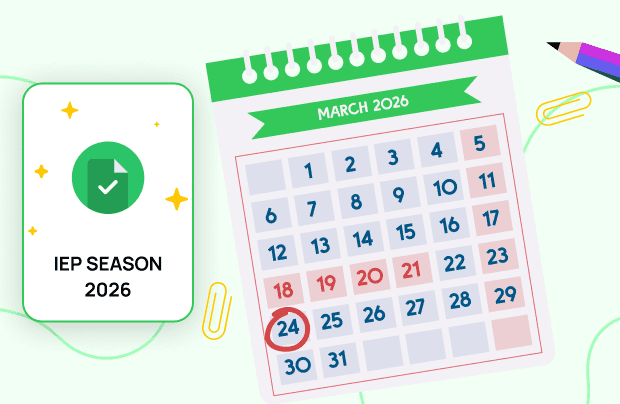
March also means IEP season is ramping up for millions of families. Annual reviews are being scheduled, and the decisions made in the next few weeks will shape your child's entire next school year. We put together a guide on how to prepare before you sit down at that table.
If you want to walk into that meeting even more prepared, join us and Dr. Dannette Taylor, a former special education administrator and leader of a 338,000+ parent and educator community, for a free live webinar on March 24th.
The Hidden IEP Costs Nobody Talks About And How Parents Can Prevent Them March 24, 2026 | 5:00 PM PT / 8:00 PM ET
[Register free at expertiep.com/drtaylor]
This Month and Every Month
Developmental Disabilities Awareness Month is a reminder that our children are seen. But being seen is just the beginning. Being served, being supported, and being given every opportunity the law provides is what we're here for.
That's what Expert IEP does every day, not just in March.